
Introduction
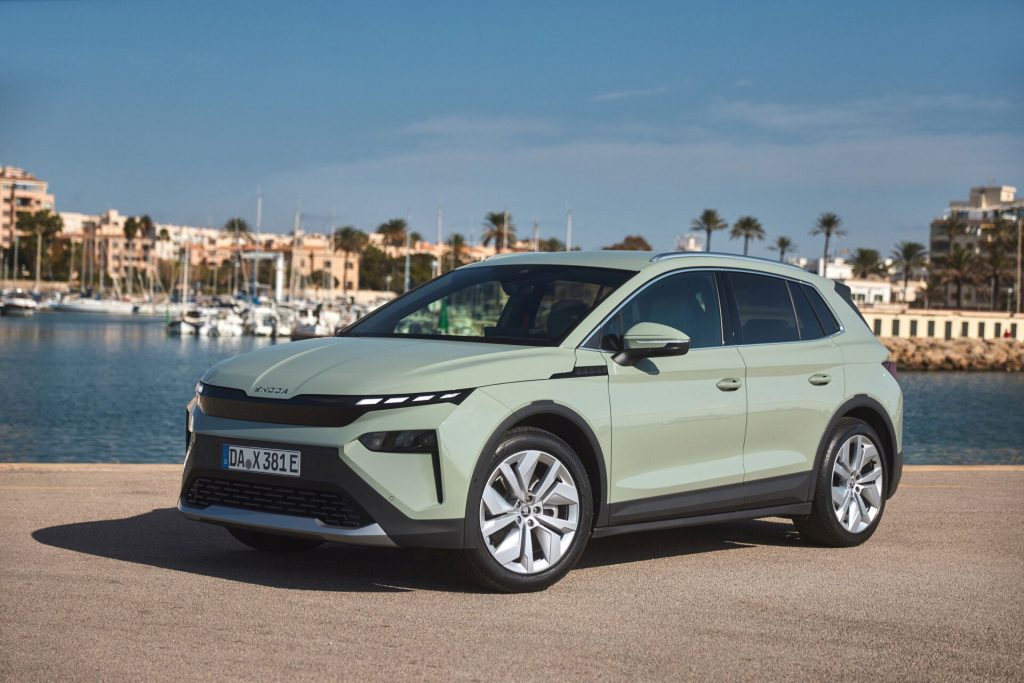
You could think of the Skoda Elroq as the Enyaq after a sensible haircut – same charm, just trimmed to fit tighter budgets and smaller driveways.
It bundles everything we’ve come to appreciate about its bigger sibling into a more compact, more approachable package. Slotting neatly into the mid-size SUV crowd, it looks sharp, feels solid, and drives with quiet assurance.
Perhaps it does not thrill, but overall, it’s the sort of car that just gets life done – gracefully.
Quick Overview
Adviser Rating: 4.6 / 5
Skoda’s Elroq takes the successful Enyaq formula and shrinks it slightly, aiming squarely at the competitive mid-size electric SUV market. It drives with a reassuring calmness, prioritising comfort and refinement over outright thrills.
From the inside, you get that familiar Skoda practicality, generous space (particularly in the rear), and sensible layout, albeit with some harder plastics here and there.
Pricing is keen, specifically at the entry-level, and company car tax benefits are a major draw.
And honestly, the warranty is a bit mean, and the drive would not excite much, but the Elroq shapes up as a very competent family EV.
Pros:
- Great all-rounder
- Spacious & clever interior
- Sensible Cabin Layout
Cons:
- Achingly Dull Drive
- Underwhelming Warranty
- Scratchy plastics on some places inside
Trims & Pricing
Skoda has gone broad with the Elroq line-up, with a version for nearly every type of driver.
There are a total of five trims, which are as follows:
- SE
- SE L
- Edition
- SportLine
- vRS
The Elroq SE 50 marks the starting point at £31,500, which undercuts almost every rival of similar size. The Kia EV3, Volvo EX30, and Renault Scenic all start higher, while even the smaller Volkswagen ID.3 costs more.
For an entry model, the SE feels well-appointed, featuring 19-inch alloys, a 13-inch touchscreen, and LED lighting all round.
Next is the SE L, available with larger 59 or 77kWh batteries. It adds comfort and practicality touches such as heated seats, a heated steering wheel, and a navigation system. Front parking sensors and tow bar preparation make it particularly family-friendly.
Move to the Edition, and things are on the premium side. Keyless entry, travel assist, and wireless phone charging come as standard.
The SportLine adds sportier styling and firmer suspension.
The top-of-the-line vRS is priced near £50,000. It’s fine but not particularly sporty, and some options, like dynamic chassis control or the £1,000 heat pump, may not justify the extra outlay.
The Elroq range feels temptingly priced. However, the options list demands restraint.
Performance & Drive
Adviser Rating: 4.8/5
The Elroq feels immediately familiar to anyone who’s spent time in a modern VW Group EV. It uses much of the same hardware, but Skoda has tuned it with a calmer, more grounded character that suits everyday driving.
Every version sends power to the rear wheels. The entry Elroq 50 delivers 170PS, the 60 rises to 204PS, and the 85 tops out at 286PS. The vRS alone adds dual motors and all-wheel drive.
Numbers aside, what defines the Elroq is its composure and quiet confidence on the move.
Driving Experience
In city driving, it’s surprisingly light and predictable. The steering has just enough weight to inspire confidence without being heavy, and visibility is excellent.
Parking is easy thanks to a turning circle of 9.3 metres, roughly the same as a Fabia, which makes tight car parks and narrow lanes less of a chore.
The throttle pedal has a long travel that helps modulate power smoothly, so darting into traffic or easing through junctions feels natural rather than abrupt.
Motorways suit the Elroq particularly well. The suspension remains settled even on the 20-inch wheels used by higher trims, and the cabin stays quiet apart from a faint rush of wind around the mirrors.
Ride quality improves with speed, and the car covers distance with the sort of calm that takes the edge off long trips. The smaller battery versions only begin to run out of breath on steeper inclines, but they never felt underpowered in real use.
When cornering, the Elroq’s body control is tidy, the suspension well-judged, and the steering is consistent. It does not invite spirited driving, but it never feels clumsy either. The 85 version brings enough shove to keep things brisk, yet the car’s demeanour stays reassuringly measured. In truth, that restraint is part of its appeal.
Comfort & Refinement
Ride comfort deserves praise. Even the firmer SportLine retains a forgiving edge, absorbing broken tarmac with a softness that feels almost plush. The optional Dynamic Chassis Control (DCC) system adjusts the suspension between Comfort, Normal, and Sport settings, and it works very well.
Refinement levels are impressive, too. Tyre and wind noise are well suppressed, particularly with the acoustic side glass fitted to upper trims. The driving position feels natural, visibility forward and rearward is excellent, and the seats offer generous support for longer journeys. It’s a car that encourages unhurried driving, where comfort and quietness take precedence.
Braking & Regeneration
The brakes are slightly spongy and need a firmer push than expected, and the regenerative system never quite manages full one-pedal operation. Even so, the paddles behind the wheel allow small adjustments on the fly, and once you adapt, it becomes second nature.
All told, the Elroq impresses through its calmness rather than drama. It’s not a car that shouts for attention, nor does it try to thrill. Instead, it builds trust with its steadiness, composure, and refinement.
Frankly speaking, it’s the kind of car that wins you over mile by mile, quietly, competently, and without fuss.
Range, Charging & Tax
Adviser Rating: 4.6 / 5
The Elroq’s on-spec-sheet figures certainly look competent, though the real-world story is, perhaps, a little more nuanced.
You get three usable battery options: 52kWh, 59kWh, and 77kWh. These deliver official WLTP ranges from 232 miles for the entry-level car up to 360 miles for the long-range ’85’ model.
Frankly, that base 232-mile range is merely adequate by today’s standards.
We’d also argue that the official efficiency claims are optimistic. In our test, the 85 model returned 3.7mi/kWh, resulting in a range of 285 miles. That’s a significant 75-mile drop from the brochure figure, albeit still competitive.
Charging, on the whole, is strong. The 85 model accepts a healthy 175kW DC charge, capable of a 10-80% top-up in 28 minutes. Oddly, the smaller batteries charge slightly faster, managing the same feat in around 24-25 minutes. We particularly like the manual battery preconditioning button; no more fighting with the sat-nav just to get full charging speeds on a cold day. The biggest gripe? A heat pump is a £1,000 optional extra.
The Elroq’s key advantage, however, lies in its tax implications. For company car drivers, the 3% BiK rate for 2025/26 is the magic number. This equates to a trivial £15.82 per month for a 20% taxpayer on the base SE 50 model. VED is zero-rated for now, but be warned: any model optioned over £40,000 gets hit with a £410 annual surcharge from year two.
Interior & Tech
Adviser rating: 4.3/5
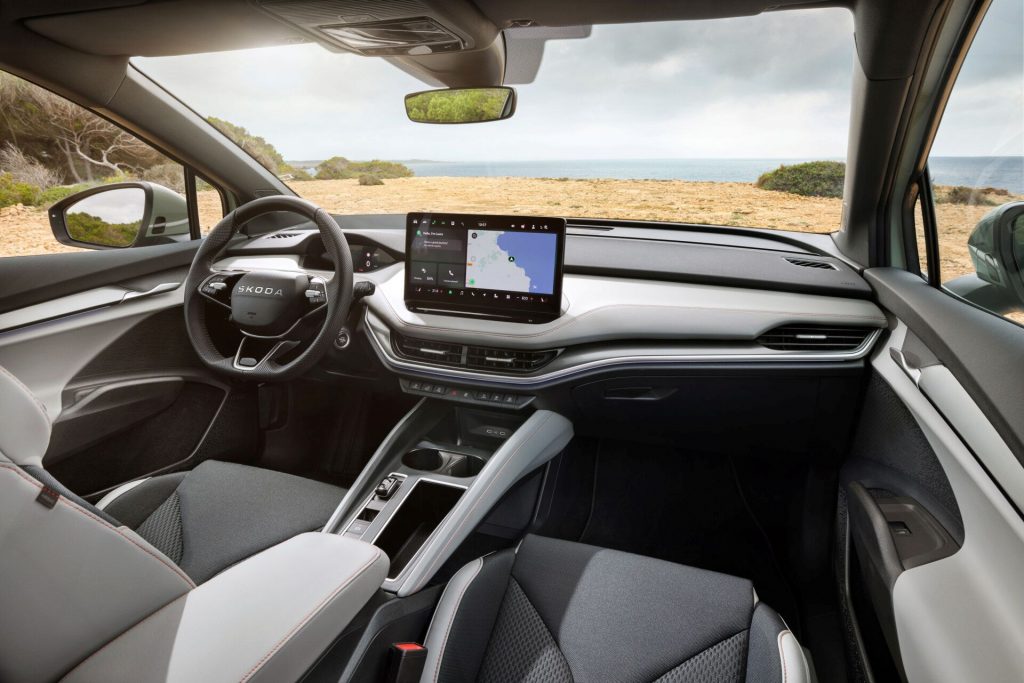
From inside, the Elroq is much the same as the Enyaq, and honestly, that’s a very good thing. Skoda seems to be the only brand in the VW Group that consistently nails interior design and practicality.
The build quality is on point, everything is screwed down properly. We’d argue the funky denim-esque fabric on the dash of lower-rung models is a more interesting choice than the leatherette on high-spec cars. Materials are generally good, but it’s a bit of a shame that cheaper, harder plastics are so prominent lower down on the dashboard and throughout the rear seats.
The real win, however, is the common-sense layout. Somehow, Skoda has avoided the dreaded haptic switches on the steering wheel and the confusing stalks plaguing its VW cousins. You get proper window switches, a row of physical buttons for important functions, and a chunky gear selector. Elsewhere, the cabin is dominated by a massive 13.0-inch touchscreen. It’s an improvement over the Enyaq’s, with updated, more responsive software and permanent climate shortcuts. We would have liked to see the neat physical control dials from the new Kodiaq, though.
In front of the driver sits a rather dinky 5.0-inch digital display. It’s clear, but perhaps not as easy to read at a glance as some alternatives; the optional head-up display would be a worthy upgrade. Wireless Apple CarPlay and Android Auto are standard, which is good, although we did find Skoda’s system a bit glitchy on our test, with CarPlay disconnecting a couple of times.
Space, Practicality, & Comfort
Adviser Rating: 4.8/5
Practicality is, of course, the ace up Skoda’s sleeve, and the Elroq does not disappoint. It’s a remarkably practical package, and we’d argue it’s more spacious inside than its own petrol-powered sibling, the Karoq.
In front, the driving position is well-judged, with hugely supportive seats. The rear is the real story; two six-footers will have ample legroom, decidedly more than in a Peugeot E-3008 and EV3. There are even smart little pockets for their phones. Only the seriously lanky will have any complaints.
Then there’s the boot. At 470 litres, it’s plenty for daily life and just edges the Ford Explorer. That said, rivals like the E-3008 (520L) and the Renault Scenic (545L) beat it, and no, there’s no frunk. Elsewhere, you get the expected ‘Simply Clever’ touches: an ice scraper in the bootlid and an umbrella in the door, just like a Rolls-Royce… sort of.
Better yet is the optional net for the charging cables that hangs under the parcel shelf. It’s a genuinely smart idea, meaning you can grab the cable without emptying the entire boot.
On the road, it’s immediately clear that the Elroq has been tuned for comfort.
On the whole, the soft suspension and big tyres deliver a cushy, almost pillowy ride, even on 20-inch wheels. Motorways are its forte. This focus has its trade-offs, however. Whilst it’s relaxing at speed, bigger potholes and speed bumps around town can leave you rocking and jiggling, with the car wallowing for a moment before it regains composure.
It’s not unnerving, but it can feel as if it’s floating above the road rather than planted on it.
Reliability & Safety
Adviser Rating: 4 / 5
The Elroq has not been hit by a Euro NCAP barrier just yet, so there’s no official star rating.
Skoda does not tend to fumble the ball here, though. The related Enyaq scored a full five stars, as have other cars on this MEB platform. We’d be surprised if the Elroq didn’t repeat that performance, with up to nine airbags and a full array of kit. That being said, the Enyaq’s test was back in 2021, and the NCAP protocol has become significantly stricter since then, so it’s not a guaranteed slam dunk.
Still, the car is certainly packed to the gills with safety tech. The standard kit is strong, with blind-spot detection, lane-keep assist, and a rear-view camera included on all models. You’ll have to move up the range for the full ‘Travel Assist Plus’ suite and the clever Matrix LED headlights, but the fundamentals are all there.
Reliability is totally unknown at this point. While Skoda’s build quality is generally solid, the car is simply too new. So we can’t say anything at this point.
Skoda’s infotainment can be glitchy; our test car dropped Apple CarPlay twice.
Perhaps the biggest letdown, however, is the warranty. The standard three-year, 60,000-mile cover is nothing special. We’d argue it looks decidedly mean when Hyundai offers five years, and Kia and MG both provide seven. You can, of course, pay to extend it, but that stings. At least the battery is covered by the industry-standard eight-year, 100,000-mile policy.
Our Verdict
So, what’s the final word on the Elroq? Well, honestly, it’s an overdose of competence. Skoda appears to have nailed it yet again, distilling all the best bits of the Enyaq. The ‘Simply Clever’ features, the vast interior space, and the relaxing, pillowy ride, into a smaller, more affordable, and rather eye-catching package. On the whole, it’s a brilliant all-rounder that majors in just about every department that actually matters to a family.
Our only real gripe? It’s a complete fun sponge. It’s easy on the eye and easy to live with, but it is achingly dull to drive. This is a car that would sooner iron your trousers than set them on fire. And whilst the warranty is mean and some of the interior plastics are scratchy, these feel like minor niggles.
Does that lack of excitement really matter? For the vast majority of buyers just wanting a sensible, comfortable, and practical EV, we’d argue it does not.