
Introduction
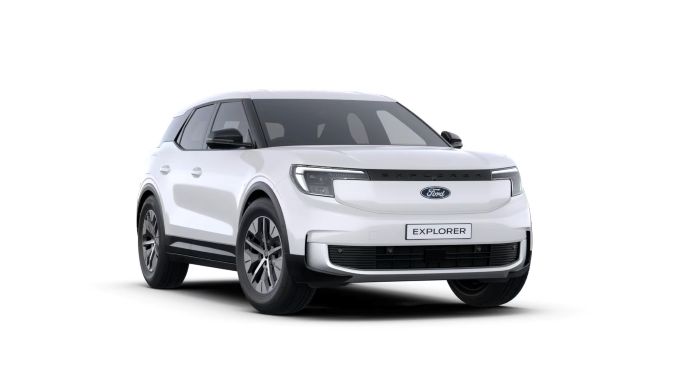
Ford has invested two billion dollars into its century-old Cologne plant to build the Ford Explorer EV, and that’s only a part of a larger five-billion EV push.
The company highlights AI in its production, with a focus on greater consistency, efficiency, and overall quality.
The Explorer appears to be a decent package, but can American design and German engineering deliver the best family EV? Given the heavy competition in the segment?
Let’s find out…
Quick Overview
Adviser Rating: 4 / 5
The Explorer is Ford’s second all-electric model after the Mustang Mach-E, built on Volkswagen’s MEB platform.
It does share a lot of underpinnings with the VW ID.4. But it would be unfair to label it literally as VW. Ford has overlaid its own bodywork, cabin, and suspension tuning. This gives the Explorer a Ford flavour rather than the sense of being a Volkswagen in new clothes.
Although marketed as an SUV, in reality, it is more like a mid-size electric family crossover. Boot space stands at 470 litres, which is plenty for daily life. However, about 70 litres less than an ID.4 and ID.5.
The design is boxier and more upright than many competitors, which lends it a purposeful stance. Ford insiders even insist it is not a direct rival to the ID.4, pointing to a 116mm difference in length.
Would anyone really notice a 116mm difference?
Pros:
- Useful Cabin
- Well specced
- OK to drive
- Loads of clever interior storage
Cons:
- Rear legroom is tight
- Bouncy Suspension
- Alternatives have bigger boots
- Some issues with infotainment
Trims & Pricing
There are three trims, which makes the range quite straightforward to understand.
The line-up begins with the Standard Range RWD Style, priced just under £38,000.
Above that, there’s the Extended Range RWD Select at £45,885. And if you want the twin-motor AWD set-up, you’re obliged to choose the top Premium specification, which costs £53,985.
Premium brings a fair amount of equipment: B&O stereo, matrix headlamps, a glass roof, 21-inch wheels, synthetic leather upholstery and a powered tailgate.
Still, not everything is included. A heat pump remains an option. It should be standard, particularly at this price. There’s also the possibility to add a towbar (yes, this EV is rated to tow) and a further package that introduces a head-up display, 360-degree camera and self-parking.
How does that compare with rivals?
The Explorer costs slightly more than a Volkswagen ID.4, and is broadly on par with a Kia EV6 or Peugeot e-3008.
Currently, this means Ford has not undercut the competition, but it is not overpriced either. The level of standard equipment does help justify the figures.
If we had to choose one, we’d say the Select trim with the single-motor RWD is the most sensible option. It brings the maximum range, sufficient performance, and avoids the high extra cost of Premium.
Perhaps the AWD will appeal in certain climates, but for most buyers, the Select feels like the right balance.
Performance & Drive
Adviser Rating: 4.3/5
Straight-line Performance
The Explorer’s performance figures are satisfactory. Not thrilling, not sluggish either. Just… fine.
The base variant rear-wheel-drive does 0–62mph in 8.7 seconds, the mid-spec cuts it to 6.4, and the twin-motor all-wheel-drive manages 5.3.
On the spec sheet, that looks like a decent spread. But in practice, the second motor does not exactly transform the car. It helps with traction at low speeds, sure, but once you’re out on faster roads, you probably would not feel much difference.
The AWD’s extra 54bhp sounds promising, yet since it also drags around an extra 70kg, the gain is not as clear-cut as you’d expect.
Refinement and Everyday Use
What strikes us most is how quiet it is. All versions stay calm, composed and almost whisper-like. This is a great asset whether navigating city traffic or covering long motorway miles.
The steering is light and very accurate. You point it, it goes there. On a winding road, it threads along with a neat, progressive feel.
Compared with the Volkswagen ID.4, the Explorer is keener, particularly at turn-in. It leans less, too, which makes it that bit more agile than you might expect from something weighing over two tonnes.
Ride and Comfort
This is where it gets interesting. Ford tuned the suspension without adaptive dampers, and the results are a bit of a mixed bag. The springs are taut, though not harsh, and the dampers give them room to settle through quicker corners.
On the motorway, body control is strong, and comfort is just fine. But there’s always a faint shimmy through the seat and steering wheel, which you notice more than you’d like.
Speaking of which, at low speeds on patchy town roads, the ride can feel busy, fidgety, even.
Having said that, it is not ruinous for long journeys. However, cars like the EV3 or ID.4 are simply more settled when it comes to everyday bumps and potholes.
Handling and Agility
Push a little harder, and the Explorer shows its best side. There’s a natural rear-drive bias, and it feels planted as a result. The stability system gently nips the inside wheel to rotate the car into bends, which works surprisingly well.
Big tyres give it plenty of grip, and there’s very little power-on understeer, which is refreshing in a heavy EV.
The steering gives good feedback when you’re leaning on it, but the mass never really goes away. You’re always reminded that this is about a 2-tonne vehicle, not some disguised hot hatch.
Pedals and Braking
Throttle response is well judged. Comfort mode is progressive and easy, while Sport sharpens the first dab of the pedal a little too much, without actually giving you more at full travel.
In other words, both maps deliver the same punch when floored, but Comfort is smoother in day-to-day use.
The brakes are progressive, though the pedal is on the soft side. You can also switch on adaptive regeneration. It usually freewheels, but it’ll slow the car automatically when traffic ahead eases off, or when you approach a junction or new speed limit. And that makes town driving less of a chore.
Single vs Twin Motor
Now, do you need the twin motor? Perhaps not. The AWD rides a touch smoother at low speed, partly because it sits 15mm higher, which helps on rougher ground. But on dry tarmac, there’s little to separate it from the mid-spec RWD.
Modern traction control is so effective that the single motor is rarely caught out. If you live somewhere with icy winters, sure, AWD might buy you peace of mind.
For everyone else, though, we’d say the single motor is neither underwhelming nor inadequate. Thus, unless conditions demand it, the AWD upgrade is more about reassurance than genuine dynamic benefit.
Interior & Tech
Adviser Rating: 3.5/5
Cabin Design and Quality
The Explorer hides its Volkswagen connections fairly well on the outside. Inside, however, the links show a little more clearly. The stalks, the driver’s display, and even the fonts are recognisably VW. The main screen also follows Volkswagen logic, in line with the newer ID.7 system.
Speaking of which, the graphics are Ford’s own, and the layout is portrait rather than landscape, which gives it a slightly different character.
Should anyone really criticise it for borrowing? We say no. If you haven’t driven a VW Group model, you probably would not even notice.
Quality is respectable. The build is solid and matches the Volkswagen ID.4 in general standards. In particular, the Explorer looks sharper and more modern. Harder plastics do appear on the top of the dashboard, though your eye is not drawn to them. They don’t spoil the impression, but neither do they completely disappear once spotted.
Infotainment and Controls
At the centre is a 14.6-inch touchscreen, mounted vertically and adjustable for angle.
On paper, this seems like a strong feature. In practice, the Sync Move software does not always keep up with expectations. The screen itself is sharp and responsive, and the vertical layout works well with split functions. For example, you can run a map on the top half and have tiles for music, driver assists, and drive modes below. The trip computer stays in the driver’s display, which is where it’s most useful for range prediction.
That being said, there are flaws. Some icons are far too small. The menu structure feels haphazard, and you can’t always find your way back with a simple ‘back’ button.
Neither are there physical controls for climate or audio, which makes everyday adjustments distracting when you’re on the move.
Even the steering wheel buttons are haptic, and we’d say they’re more gimmick than genuinely helpful.
At least the design of the graphics is Ford’s own, so the interface avoids feeling like a straight copy of VW’s. And if you choose the Premium trim, the B&O Play sound system is a highlight.
Space, Practicality & Comfort
Adviser rating: 4.2/5
Cabin and Seating
The Explorer’s cabin has a light feel, helped by pale finishes and a fabric soundbar running across the dash.
The front seats themselves are good. Tall-backed, with supportive curves, and plenty of adjustment. Straight-ahead pedals and a range of seat and wheel movement make it easy to find a natural driving position.
On Select and Premium trims, you even get electrically adjustable seats with massage for the driver.
The squared-off steering wheel is less universally appealing. It does free up a view of the driver display, though the display itself is small and concise enough to sit neatly beneath the rim.
Some will like the wheel, others will need time to adjust. An acquired taste, in other words.
As for space, the Explorer is competitive with its main rivals. Four tall adults fit comfortably, but the VW ID.4 and Skoda Elroq still edge ahead on rear legroom.
Boot and Storage
The boot measures 470 litres. That’s nearly 70 litres less than an ID.4, but it remains plenty for family use. There’s no load lip, a height-adjustable floor, 60/40-split rear seats, and even a ski hatch for longer items.
Beneath the floor, you’ll find a little extra storage, though not enough to swallow charging cables. And no, there is not a front boot. Should there be one in a modern EV? Definitely yes.
Inside the cabin, Ford has been far more generous. There is the so-called Megaconsole. It’s a 17-litre box under the front armrest, large enough for a laptop bag. Cupholders can be clipped on top of the console or removed altogether, freeing up space for a tray or a huge covered bin.
Speaking of clever ideas, there’s also a hidden lockable cubby behind the infotainment screen. It secures when you lock the car, which is a neat way to stash valuables out of sight. Between the rear seats, you get another large, divisible storage box. Again, sized more like office equipment than small-car clutter.
Comfort
On the move, the Explorer feels generally accommodating. The seats are supportive, adjustment is wide-ranging, and the sense of lightness in the cabin helps avoid any feeling of confinement.
It may not have quite the stretch-out legroom of an ID.4, but it’s roomy enough for most families.
Range, Charging & Tax
Adviser Rating: 4.2 / 5
The Explorer’s battery options give it a clear hierarchy.
The base single-motor version carries a 52kWh pack, officially rated at 233 miles WLTP. That’s workable for urban and short-commute use, though it looks modest next to competitors.
Move up to the 77kWh battery and the claimed figure rises sharply to 374 miles (officially). In practice, we saw around 325 miles in mixed driving. Still strong, and probably the one most buyers will gravitate towards.
The dual-motor version gets a 79kWh pack. You might expect a big jump here, but the gains are marginal.
Range takes a hit compared with the single-motor extended version, and while it can charge a fraction quicker, it hardly changes the overall equation. So, do you really need the second motor?
On AC, every Explorer comes with an 11kW onboard charger. That means seven hours flat-to-full on a three-phase supply, or about ten and a half hours on the more common 7.4kW home wallbox. Manageable overnight, in other words.
Fast charging is more competitive. The 77kWh battery peaks at 135kW, while the 79kWh pack rises to 185kW. Either way, you’re looking at roughly half an hour for a 10–80 percent top-up.
Ford has also added preconditioning. The battery warms or cools itself in advance if the charger is set in the navigation, or you can trigger it manually with a button.
Speaking of which, that’s a really handy feature if you want to get the best speed out of public chargers on a cold morning.
Running Costs and Perks
On a typical UK tariff, a full home charge works out at around £20. That’s not bad for more than 300 miles of real-world range, and it could be less if you’re on a cheap overnight electricity deal.
Public charging, in particular at ultra-fast points, is another story. Costs can rise quickly, and at times they approach the price per mile of petrol.
Ford does sweeten the deal a little. Some charging network subscriptions are bundled in for the first year, which saves a bit of hassle, and five years of servicing is included (consumables aside).
For company car drivers, the Explorer’s low Benefit-in-Kind rate will be a big attraction.
Hence, as of now, it makes more sense as a fleet-friendly EV than many petrol or diesel alternatives.
Reliability & Safety
Adviser Rating: 3.5 / 5
The Explorer has achieved a full five-star Euro NCAP rating. All versions come well-equipped with driver assistance systems. Autonomous emergency braking, front and rear parking sensors, and a reversing camera are all included. The basics, otherwise stated, are covered.
Reliability is trickier to pin down. Neither Ford nor Volkswagen are exactly known for topping the charts in this area. Electric cars are mechanically simpler, which does reduce the risk of traditional failures, but software is another story. Many EVs suffer from glitches early on, and it has yet to be determined how the Explorer copes as the miles and updates accumulate. Perhaps it will settle quickly, perhaps not.
Ford’s standard warranty covers three years or 60,000 miles. That’s in line with the industry average, but nothing more. You can extend it to five years or 100,000 miles if you’re willing to pay.
However, when competitors like Kia provide seven years as standard, and Toyota goes as far as ten, Ford’s package looks conservative.
The battery is covered for eight years or 100,000 miles, which is standard practice across most of the market.
That being said, for company car drivers or private buyers alike, the warranty length could make a difference.
Would you feel more reassured by seven years of cover? Probably. And in a sector where peace of mind counts for a lot, Ford might find itself at a slight disadvantage here.
Our Verdict
The Ford Explorer EV is a good-looking car inside and out, and its cabin proves practical in everyday use. Storage has been well thought through, the seating is comfortable, and while the infotainment has its flaws, the overall tech package is competitive.
Range and charging speeds are respectable, particularly with the extended battery, and running costs remain sensible if home charging is an option.
Not every driver will warm to it straight away, but that could be said of most rivals in this segment. As a family EV, it’s likeable and capable, even if some elements such as ride comfort and software leave room for improvement.
If you liked this review, keep visiting Car Adviser.