
Introduction
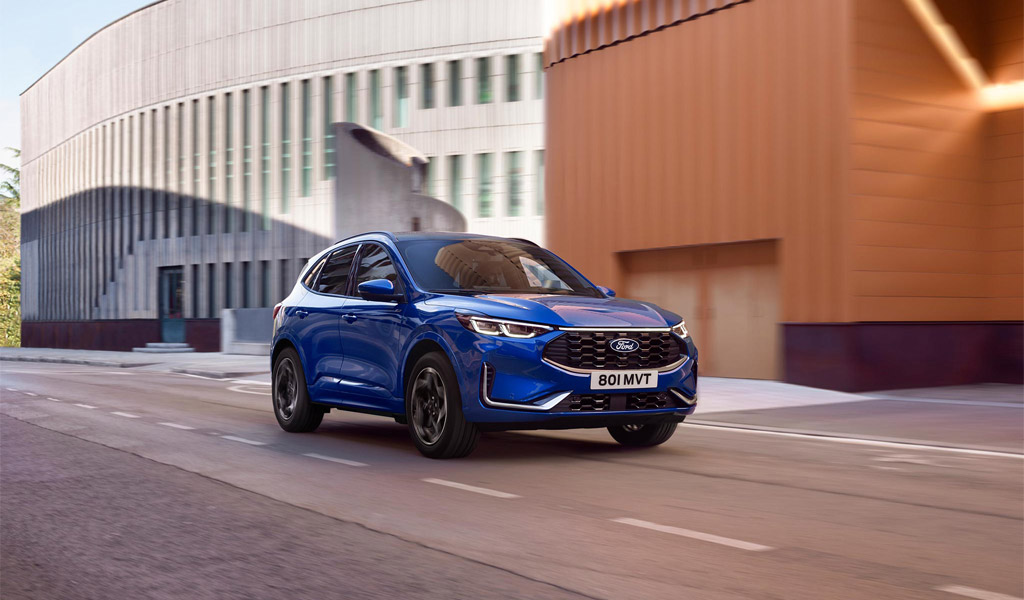
Some family cars simply do what’s expected of them. The Ford Kuga sets out to do more. It offers petrol, hybrid and plug-in hybrid power alongside the space and efficiency families value most. Practical yet composed, it feels thoughtfully engineered for everyday life.
On the spec sheet, it looks like a solid all-rounder. But can it really stand apart from its rivals? Let’s find out…
Quick Overview
Adviser Rating: 4.1 / 5
The family SUV class is jam-packed with tough contenders such as the Hyundai Tucson, Kia Sportage, Mazda CX-5 and Volkswagen Tiguan. The Ford Kuga steps into this mix with petrol, full hybrid and plug-in hybrid power options.
Whichever you pick, there’s a sense of engagement and control that feels characteristically Ford.
From inside, the cabin feels roomy and versatile. The sliding rear seats and high driving position suit everyday family use, although the boot is smaller than some rivals. Cabin materials are mixed, but the SYNC 4 infotainment and digital driver display create a modern impression.
Strong safety results and generous equipment help the Kuga remain one of Ford’s most complete SUVs.
The full-hybrid version is our recommended choice.
Pros:
- Engaging to drive for a family SUV
- Efficient hybrid and plug-in hybrid choices
- Spacious interior with flexible seating
- Strong safety and technology features
Cons:
- Smaller boot than key rivals
- Cabin plastics feel average
- Ride can be firm on some trims
- Reliability record remains mid-table
Trims & Pricing
You’re not given many choices with the Ford Kuga. The range comes in four trims:
- Titanium
- Active
- ST-Line
- ST-Line X
Each version is positioned with intent. The options focus on comfort, appearance, and performance.
We appreciate how clear and uncomplicated the line-up feels for the everyday driver.
And yes, there’s no diesel or fully electric version if that’s on your wish list.
The Titanium opens the line-up with solid essentials such as:
- LED headlights
- 17-inch alloys
- Cruise control
- Keyless entry
- Heated windscreen
It leans toward comfort rather than sport.
The Active adds raised suspension and tougher exterior details that create a more adventurous look.
The ST-Line is the most popular model. It brings sport-inspired styling, firmer suspension and extra features such as adaptive cruise control and 12-way adjustable front seats.
The ST-Line X completes the range with 19-inch alloys, a panoramic roof and heated seats in both rows.
Prices start at about £32,000 for the 1.5-litre petrol model, rise to roughly £38,500 for the full hybrid and reach around £40,500 for the plug-in hybrid.
Considering its specification and driving character, the Kuga feels fairly positioned within the class.
Of the range, the ST-Line stands out as our pick for its blend of refinement, design and road feel.
Performance & Drive
Adviser Rating: 4.2 / 5
Ford has a long history of getting the driving feel right, and the Kuga continues that…
The steering feels precise, and the suspension keeps the body well controlled. It feels predictable and settled through bends.
Each version carries that core ability, although their personalities vary somewhat once you start spending time behind the wheel.
Engine and Hybrid Performance
The 1.5-litre EcoBoost petrol produces 148bhp and reaches 62mph in 9.5 seconds. A six-speed manual gearbox accompanies it, offering a short and reassuring shift that feels properly engineered.
Because this setup keeps weight low, the Kuga feels lighter on its feet than many SUVs of this size. It’s steady and secure on the motorway, yet the absence of an automatic gearbox in this version does limit appeal for those facing regular city traffic.
The 2.5-litre full hybrid (FHEV) provides a broader spread of ability. It manages 0–62mph in 8.3 seconds with all-wheel drive or 9.1 seconds with front-wheel drive. The switch between petrol and electric power happens quietly, without the hesitation some hybrids show.
Short runs in pure-electric mode make stop-start driving more relaxing.
The hybrid system works with purpose and composure, which is why it’s arguably the most sensible choice in the range.
The plug-in hybrid (PHEV) is brisker still, reaching 62mph in 7.3 seconds and covering around 43 miles on electricity alone.
There’s a strong pull from low speeds, and performance feels effortless once up to pace. However, under hard throttle, the CVT gearbox allows the engine to flare noisily, which slightly undermines the otherwise calm character.
Ride Comfort and Refinement
Ride comfort varies by trim. Titanium and Active versions focus on compliance, taking the edge off rougher tarmac but allowing more body lean in corners.
ST-Line models firm things up for sharper responses, though the suspension becomes rather unforgiving on patchy urban roads. Opting for 20-inch wheels only exaggerates that stiffness.
On the whole, refinement is impressive. Road and wind noise remain low, and the hybrids cruise with a level of polish that feels well above the class average.
The Kuga might not be the softest SUV, yet its steering accuracy, balanced chassis and all-round poise make it one of the most satisfying to drive in general principle.
Interior & Tech
Adviser Rating: 3.6 / 5
The interior quality has its pros and cons. The cabin feels modern, clean, and minimal. However, when looking closer, the material feels a little hard and hollow. The upper side of the dashboard and armrest are nice and soft. But lower down the cabin, the density and the finish are the same as you’ll find in the Mazda CX-5 or VW Tiguan.
The overall design is straightforward and, yes, functional, but nothing visually exceptional, and does not feel upmarket.
Kuga has a 13-inch touch screen with Ford’s latest SYNC 4 system. The display is crisp and responsive, with built-in navigation, Apple CarPlay, and Android Auto.
There’s also a 12.3-inch digital driver display that is standard across the range.
Modern vehicles are moving most of their controls to the touchscreen to give the cabin a more minimal feel. Ford did the same with the Kuga, which we are not so fond of. Even adjusting the temperature while driving is really distracting.
This is something we like about the Hyundai Tucson and Mazda CX-5. They have physical controls.
Higher trims benefit from extras such as a Bang & Olufsen audio system, wireless charging, and adaptive matrix headlights.
Space, Practicality, Comfort
Adviser Rating: 4.5 / 5
Front Cabin Space and Storage
The Kuga feels properly roomy, the sort of car that welcomes you in rather than just accommodating you.
The front cabin is broad and open, helped by a tall roofline that gives plenty of headroom.
Legroom is generous too, so even tall drivers can stretch out in comfort.
The seats are supportive and offer ample adjustment, meaning it’s easy to get settled behind the wheel.
Around you, there’s a satisfying amount of storage: a deep central bin, twin cupholders, a tray for your phone, and a 12V socket nearby.
Higher trims add wireless charging and USB-A and USB-C ports.
The only real quirk is the narrow front door pockets that just about manage a 500ml bottle.
Rear Seat Accommodation
Once you climb into the back, the sense of space continues.
There’s strong legroom and headroom, and the wide glass area keeps things feeling light and open. The sliding rear bench gives a useful degree of flexibility, letting you prioritise either luggage space or passenger comfort, and the backrests recline for an extra touch of ease on longer trips.
It’s also one of those cars that makes family life simpler: the rear doors open wide, and the ISOFIX mounts are sensibly positioned, so fitting a child seat does not turn into a wrestling match.
Boot and Practical Features
The boot sits at 412 litres with the seats all the way back, expanding to 553 litres when slid forward.
It’s not the biggest in its class, yet it’s cleverly shaped and easy to load thanks to a flat entry.
The flush floor, tie-down points, and hands-free tailgate add a sense of polish, while plug-in hybrid versions get an underfloor space for cables.
Quite honestly, the Kuga feels designed by people who actually use their cars every day.
Fuel Economy & Running Costs
Adviser Rating: 4.2 / 5
Running costs in the Kuga depend a great deal on which engine you go for, and how disciplined you are with charging.
The 1.5-litre petrol returns around 44mpg officially, perfectly fine for light use but not what you’d call frugal.
The 2.5-litre full hybrid is far better balanced. It averages just over 50mpg in real life, and the smooth hybrid system makes town driving almost silent.
You could say it delivers diesel-like economy without any of the diesel clatter.
The plug-in hybrid tells a more complicated story. On paper, it claims north of 300mpg and emits a token 23g/km of CO₂.
In practice, you’ll only see those numbers if you charge often and keep to shorter trips. Once the battery’s empty, it settles around 50mpg, which is not bad considering the weight.
The electric-only range of about 40 miles is enough to cover most commutes, and a full top-up from a 7kW wallbox takes roughly three and a half hours.
Company car users stand to gain the most thanks to its low Benefit-in-Kind rate, though higher trims flirt with the £40,000 threshold and the road-tax supplement that follows.
Servicing is every year or 10,000 miles, and insurance sits between groups 20 and 27.
It’s a car that rewards routine more than luck.
Reliability & Safety
Adviser Rating: 4 / 5
Reliability is something of a split verdict for the Kuga. The petrol and full hybrid models have built a steady reputation for dependability, but the plug-in hybrid has stumbled a few times.
Early cars suffered from battery-related recalls, including overheating concerns, and later issues cropped up around the fuel heater and telematics module, which could interfere with the car’s emergency call system.
Hardly the end of the world, but enough to dent confidence a little.
Warranty cover is fairly standard: three years or 60,000 miles as default, with the option to stretch it to five years or 100,000 at extra cost.
The plug-in hybrid battery enjoys a more generous eight-year, 100,000-mile guarantee, which brings some reassurance for long-term owners.
Safety is a stronger chapter. The Kuga scored five stars in Euro NCAP’s 2019 test, earning 92 percent for adult protection and 86 percent for children.
Even base trims come with automatic emergency braking, lane-keeping assist, adaptive cruise control, and sensors front and rear. ST-Line models and above gain blind-spot monitoring, rear cross-traffic alert, and an optional 360-degree camera.
Add in the available matrix LED headlights and a Thatcham Category 1 alarm system, and the Kuga feels properly equipped to protect both its passengers and itself.
Our Verdict
The Kuga feels like the point where Ford finally got its family SUV formula right. It’s grown up, confident, and packed with the sort of engineering know-how that’s made the Fiesta and Ford Focus so well regarded. The handling is precise, the steering natural, and it manages that rare trick of being genuinely enjoyable to drive without sacrificing comfort or ease of use. Few rivals in this class offer that kind of connection between driver and car.
Inside, it’s spacious and well equipped, with thoughtful touches throughout, yet the materials still let it down. Some surfaces feel cheaper than the price suggests, and rivals such as the Sportage and Tucson simply look and feel more polished.
It’s not a deal-breaker, but it’s the one area where the Kuga still feels half a step behind.
The full hybrid is the sweet spot, solid performance with diesel-like economy, while the plug-in hybrid makes sense for those who can charge at home.
Reliability has not been flawless. Early plug-in models suffered a few battery recalls. But Ford has addressed these issues and offers a long battery warranty for reassurance.
All in, the Kuga is not perfect, but it’s honest, composed, and quietly enjoyable. It finally feels like a proper class contender.