
Introduction
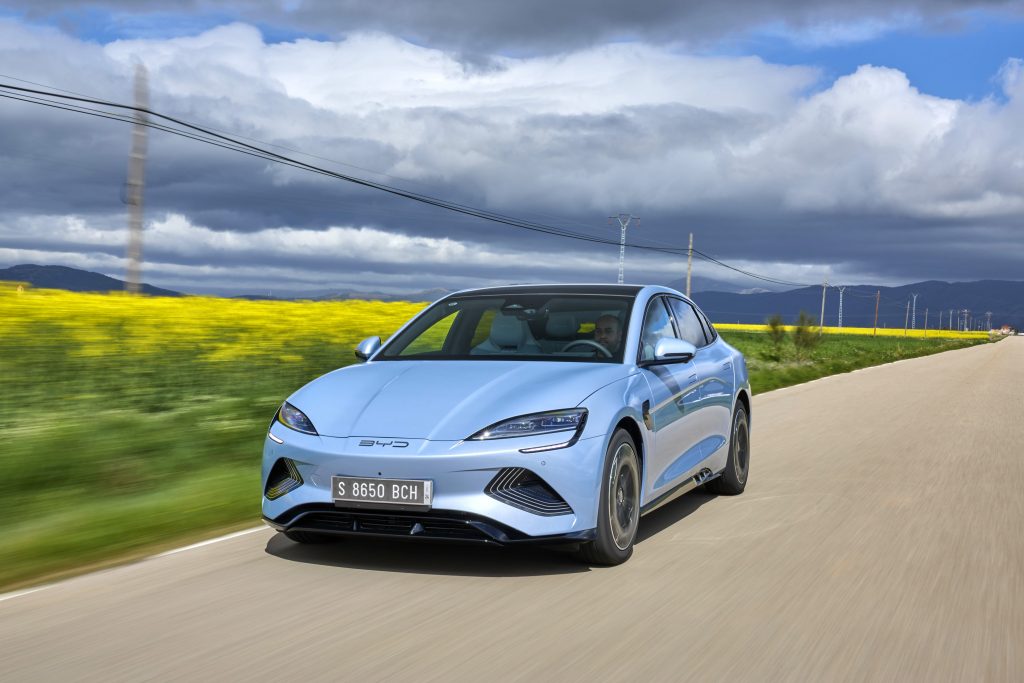
The BYD Seal might have a name that sounds odd, but the car itself takes things very seriously. In fact, BYD, short for “Build Your Dreams”, sells more electric vehicles (EVs) than any other brand globally.
The Seal is a sharp electric saloon aimed squarely at the Tesla Model 3. It is positioned above the Dolphin and Atto 3 in BYD’s line-up and brings strong numbers to back up its ambition.
So, can the Seal compete with the best electric cars for performance, range, and charging speed? Let’s find out.
Quick Overview
Adviser Rating: 4.3/5
BYD has only been selling cars in the UK since 2023, but the Seal shows none of the inexperience you might expect. This is a confident, well-executed electric saloon that competes with Tesla Model 3 and Hyundai Ioniq 6. In fact, in some areas, it’s better than both.
As we see it, it’s BYD’s most convincing car yet. The design is familiar, the shape close to the Model 3. Yet, it has better interior and ride comfort.
There’s some serious performance, too. The top of the line variant hits 0-60mph in just under four seconds. Plus, the entry level trim officially has 350 miles of range.
We are impressed by how generously equipped it is. If you’re considering an electric saloon and aren’t sold on the idea of a Tesla, the Seal is worth a closer look.
Pros:
- Strong performance, particularly the AWD model
- Generous standard equipment
- Impressive interior build quality
- Comfortable ride
Cons:
- Road noise on rough tarmac
- Rear seat comfort is somewhat compromised on longer journeys
Trims & Pricing
BYD launches two models of the SEAL in the UK market:
- Design – RWD (rear-wheel-drive) priced from £45,705.
- Excellence Dual-Motor AWD (all-wheel-drive) priced from £48,705.
Both variants come well equipped as standard. You get:
- 19-inch alloy wheels
- Heated and ventilated front seats
- Dual-zone climate control
- Powered boot lid
- Adaptive cruise control
- Keyless entry
- Heat pump (to improve cold-weather efficiency)
The differences, however, between trims come down mostly to performance.
The Design produces 313hp and claims to have a 354-mile range. Meanwhile, the Excellence adds a second motor that increases power to 530hp. However, it reduces the range slightly to 323 miles.
If we had to recommend one, the Design trim makes sense for most drivers. It’s fast, well-specced, and offers more range for less money. Having said that, pricing is on the higher side. For context, the Tesla Model 3 Long Range currently starts from under £45,000 and offers similar range and features. BYD’s strong equipment list helps justify the cost, but brand recognition and resale value may still give some buyers pause.
Performance & Drive
Adviser Rating: 4.5/5
Faster Than Expected, Even vs Tesla
Seal delivers serious performance, even the basic RWD “Design” variant covers 0–62 mph in just 5.9 seconds! Quite surprisingly, this is very close to but slightly slower than the Tesla Model 3 RWD.
The Excellence model takes it to the next level with 530hp and dual motors. It sprints 0–60mph in just 3.8 seconds. That’s blazing fast, quicker than the Model 3 Long Range AWD but not the flagship Model 3 Performance (which is quicker still at 2.9 seconds 0–60mph). And it’s repeatable.
Balanced Ride, But Not Flawless
Both versions handle impressively well. Plus, the Excellence adds torque vectoring and semi-active dampers. Not much of a difference, though if we compare with the Design trim, but still a point to consider.
Now, as for ride control, it’s well judged, body movement is kept in check, and there’s enough comfort for everyday roads. Larger bumps are managed smoothly, though at higher speeds, coarse surfaces can unsettle the ride.
Steering feel is one of the weaker points. It feels vague around the centre and becomes inconsistent through corners. Switching to Sport mode improves response, but it still lacks real feedback.
The brakes show similar traits, grabby at low speeds unless you’re in Sport, where they become easier to modulate.
Sport mode brings more consistency, even if proper feedback is still missing.
Quiet Cabin, But Not the Best in the Segment
Noise levels are well managed. Wind noise stays low, even at motorway speeds. Road noise is more noticeable on rougher surfaces, but never becomes intrusive.
The Seal is quieter than a Hyundai Ioniq 6 or Polestar 2, though not as well damped as the Volkswagen ID.7.
There’s no one-pedal driving. Just two levels of regenerative, neither strong enough to bring the car to a full stop. That’s a miss if you’re used to one-pedal systems.
Around the city, the Seal is easy to live with. Forward visibility is good. Rear visibility is limited, but all models get front and rear sensors plus a 360-degree camera.
The Seal does not offer the engagement of an Audi e-tron GT or Porsche Taycan. It’s not quite as sharp as a Model 3 either. But it’s fast, refined, and more capable than you might expect. It does the job and then some.
Range, Charging & Tax
Adviser Rating: 4/5
Strong Claimed Range, Lower in Real-World Use
BYD Seal Design and Excellence, both versions have only 82.5 kWh battery option.
The Design trim, which is rear-wheel drive (RWD), has an official range of 354 miles. Whereas the all-wheel-drive (AWD) Excellence trim is slightly behind with 323 miles of range. But that’s on paper, let’s see how it performed in the real-world conditions.
In our test, the design model managed 255 miles before coming to a stop. It’s below the official figure and around 40 miles less than the Tesla Model 3 Long Range achieved on the same route. That being said, please note that the test was conducted in winter conditions, so range performance is likely to improve in warmer weather.
Charging Speed Falls Behind the Best
Talking of the charging speed, it’s fine, but not a class-leader. The Seal peaks at 150kW on DC. That gets you from 10% to 80% in roughly 38 minutes.
It’s lagging behind rivals like the Ioniq 6 (220kW), ID.7 (175kW), and Tesla Model 3 (up to 250kW). Kia EV4 has the same 150kW support, however, it tops up 10%-80% in around 30 minutes.
Charging at home is handled by an 11kW onboard charger, which is typical for this class. A heat pump is standard on all models, which helps efficiency in cold weather.
Low Tax and Company Car Appeal
Tax-wise, the Seal benefits from the usual EV advantages. Company car drivers will appreciate the 2% Benefit-in-Kind (BIK) rate, and private buyers pay the zero-rate of road tax.
As of writing, the Seal avoids the £40,000+ luxury tax applied to combustion models in years two to six.
The Seal may not be the fastest to charge, and its range is not exceptional, particularly with strong competitors around. But in our opinion, it’s a well-balanced package, considering its value for money. Sure, you’ll have to make a few compromises, but overall, it holds its own in a competitive segment. And it still earns a place on your shortlist.
Interior & Tech
Adviser Rating: 4.1/5
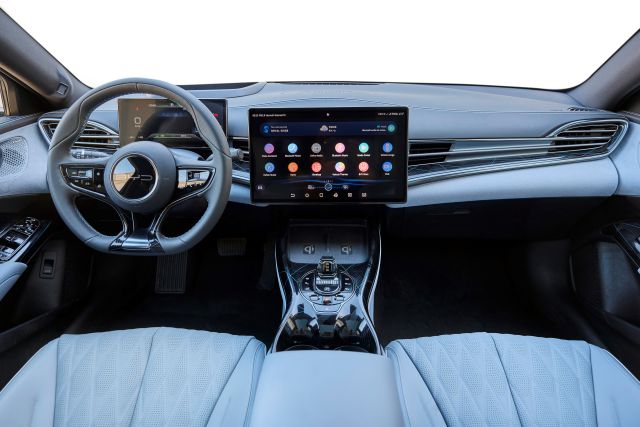
Seal’s interior is well-designed. It is modern and distinctive, not premium in every detail but solid overall.
Front seats come with electric adjustment and lumbar support as standard. The driving position is low but sensible. Visibility ahead is fine. However, over-the-shoulder checks are rather difficult. The rear windows are small and the roofline slopes sharply. Thus, rear visibility is quite restricted.
To help with that, all models come with a 360-degree camera and front and rear parking sensors. The camera system includes a virtual view of the car on the screen. It works well, but the sensors give only a visual alert, not an audible one.
Screen Impresses Visually, Less So Functionally
The 15.6-inch infotainment screen is the cabin’s centrepiece. It can rotate 90° between portrait and landscape. In portrait, maps are easier to follow. However, Apple CarPlay and Android Auto only work in landscape mode.
The icons are big. That helps on the move. The response time is not especially impressive.
Although the screen looks great, there are too many features buried in menus. You’ll need several taps to change simple settings. Climate controls, for example, are not easy to reach quickly.
On top of it, there’s a voice control feature, which is convenient. Although we aren’t fan of it, as it often asks for confirmation commands which further slows things down.
The instrument display is basic. Some information, like live charging stats, can distract from more useful data such as speed. The Excellence version adds a head-up display, which improves things to a certain extent.
Quality Up Top, Compromises Below
Build quality is mixed. Upper surfaces feel soft and well finished. Lower down, you’ll find harder plastics and some wide panel gaps.
One useful feature is the manual volume scroll wheel. It lets you switch between audio and nav volume without requiring the screen.
It’s a comfortable cabin overall. You get the spec you need. But the interface is clumsy and would benefit from a few simple buttons.
Space, Practicality & Comfort
Adviser Rating: 4.2/5
The BYD Seal does well on cabin space, particularly in the front. There’s plenty of headroom and legroom for both driver and passenger, even with the panoramic roof.
The seats are supportive, and most drivers will have no trouble finding a comfortable position.
Storage is generous, with large door bins, a deep central cubby, a wireless charging pad for two phones, and adjustable cupholders in the centre console.
Rear space is more of a mixed result. Legroom is decent, helped by a flat floor. But headroom is slightly compromised by the sweeping roofline. Taller adults will need to duck slightly when getting in, though once seated, the glass roof gives an airy feel.
Unfortunately, the rear seat design lacks proper under-thigh support. The cushion is low, and your knees sit above your hips. It’s not uncomfortable at first, but it’s not ideal for long journeys.
Rear passengers get a USB and USB-C socket, a fold-down armrest with cupholders, and wide-opening doors that make fitting a child seat straightforward.
The ISOFIX mounts are behind plastic flaps and are easy to access. There’s also a pair of reasonable door bins, though they’re made from harder plastics than the rest of the cabin.
Boot Space & Everyday Features
Boot space is 400 litres, which matches the Hyundai Ioniq 6 but trails the Tesla Model 3 and Kia EV4.
We managed to fit seven carry-on cases, which is fine for family trips. There’s underfloor storage for charging cables, plus a 53-litre front boot for extras. Unlike some competitors, the Seal at least gives you a useful frunk.
The main issue is the boot opening. Like many saloons, the narrow aperture makes it difficult to load tall or bulky items. BYD ATTO 3 and Dolphin are much better in that regard.
You won’t find tie-down hooks or power sockets in the boot, but there is a small netted compartment for loose items.
The door design also leaves the sills exposed, which means you might brush your trousers against dirt or moisture getting out.
One smart touch is the glass roof, which can be made opaque at the press of a button. It solves the usual heat and glare problem without a physical sun blind.
The Seal gets a lot right in terms of space, comfort, and thoughtful features. But there are some compromises that hold it back from being one of the most practical choices in its class. It’s close, but not quite the complete package for everyday usability.
Reliability & Safety
Adviser Rating: 4.6/5
BYD is well established globally, but it’s still a relatively new name in the UK. There’s no long-term reliability data yet, though we haven’t encountered any issues ourselves, and our experience so far has been trouble-free.
The Seal comes with a six-year or 93,000-mile vehicle warranty, more generous than what most premium rivals offer. The battery is covered for eight years or 124,000 miles, with a minimum 70% capacity guaranteed. The electric motor also carries an eight-year warranty, though with slightly lower mileage cover.
BYD Seal scored five stars in its Euro NCAP crash test, putting it on par with class leaders. The Hyundai Ioniq 6 did slightly better in adult protection, but the difference is marginal.
All models come with a full suite of standard safety features, including:
- Automatic emergency braking
- Blind-spot detection
- Lane assist
- Front and rear cross-traffic alert
- Traffic-sign recognition
So far, we’ve seen no red flags. The safety kit is complete, the crash test result is strong, and the warranty cover is more than most. Now it just needs time to prove itself.
Our Verdict
The BYD Seal makes a strong case on value, comfort, and performance. It’s not perfect, but it doesn’t feel like a compromise either. You get some serious speed, generous equipment, and a cabin that feels well resolved in most areas.
However, the touchscreen, charging speeds, and rear-seat comfort could have done better. It does include generous equipment that justifies its price point, though brand and resale concerns may deter some buyers.
If you’re not tied to a Tesla badge, it’s worth a look.
Found this helpful? For more expert car reviews and buying advice, stay tuned to Car Adviser.