
Introduction
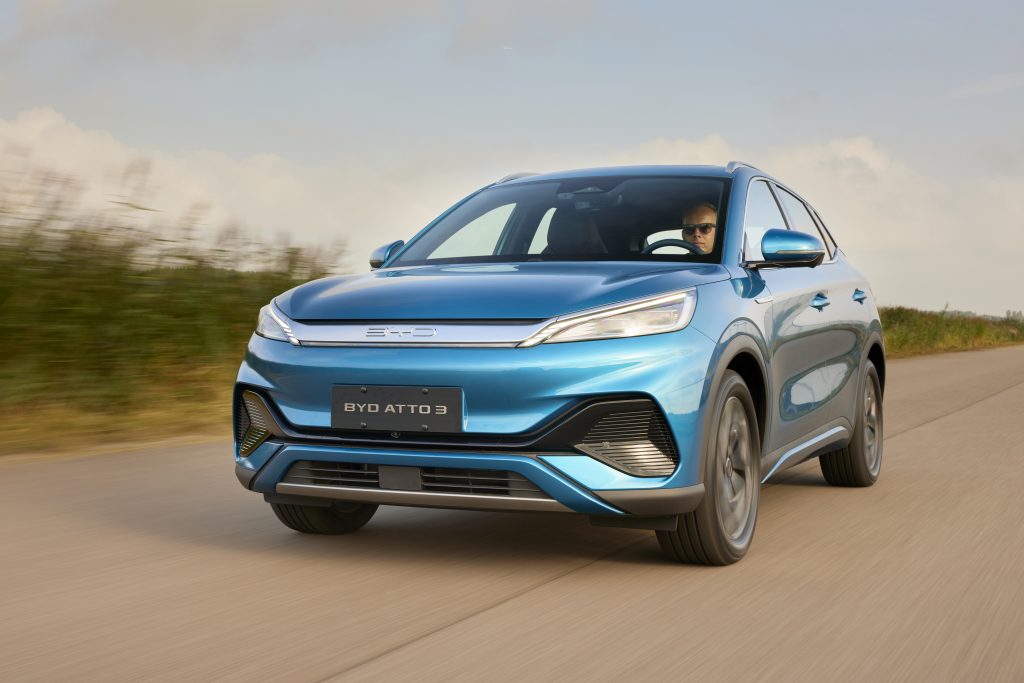
BYD stands for “Build Your Dreams”. You may not know the name, as it’s fairly new in the UK. But globally, it’s huge. It sells more electric cars than any other brand, even surpassing Tesla and VW Group.
BYD is a Chinese brand, and if you’ve ridden an electric bus in London, chances are, it was built by them. In fact, In 2024 alone, BYD sold over 4.2 million vehicles. And the Atto 3 was its first car launched in the UK.
Quick Overview
Adviser Rating: 4/5
BYD, short for “Build Your Dreams”, founded in 1995 as a battery manufacturing company, later in 2023 they got into the automotive manufacturing.
Thereafter, BYD has grown fast. It now sells more electric vehicles globally than any other brand. The Atto 3 was its first car to reach the UK, followed by the Dolphin and Seal.
All trims use the same 60.5 kWh battery, delivering a respectable 260 miles range in official tests.
It’s a decently-equipped electric SUV, sized to compete with models like the MG ZS EV. But priced higher and positioned slightly more premium.
As we see, it’s very well priced given how generously equipped it is. If we had to recommend one, we’d go for the Comfort trim.
Pros:
- Very well priced considering the high standard spec
- Strong Euro NCAP safety rating
- Battery is cobalt-free
- Bidirectional charging
Cons:
- No lumbar support on any trim
- Handling lacks precision and feel
- Rear headroom is tight
- Wind noise noticeable at motorway speeds
Trims & Pricing
There are just two versions of the BYD Atto 3: Comfort and Design. That’s it. No long list of packs. No confusing extras.
The Comfort trim starts at £37,705 and the Design starts at £39,705. Both come well-equipped.
With comfort, you get: heated front seats, faux-leather upholstery, adaptive cruise control, keyless entry, and a vehicle-to-load function. There’s also an opening panoramic sunroof fitted as standard.
The Design trim adds a 15.6-inch rotating touchscreen, a powered tailgate, and a PM2.5 air purification system.
We reckon it does not justify the £2,000 jump. You’re not getting better performance or more range.
Comfort already covers the features most buyers will care about. You won’t miss out on the core tech, and the cabin still feels decently equipped.
Given the kit included, the Atto 3 is priced competitively. It undercuts premium EVs like the Hyundai Kona Electric or Kia Niro EV, specifically once you match the spec levels. And because there are no paid options to worry about, you know exactly what you’re getting.
If we were choosing, we’d go for Comfort. You’re getting the same battery, the same motor, and almost all the same features. It’s the better value by a clear margin.
Performance and Drive
Adviser Rating: 3.3/5
BYD Atto 3’s two trims come with a 204bhp front-wheel-drive electric motor.
It’s responsive in town and quiet off the line. We recorded 0–60 mph in 7.3 seconds. That’s quick enough for most daily use. However, If you want something faster, you could check out the BYD Seal or Kia EV5.
City driving suits the Atto 3. Its soft suspension handles potholes and speed bumps without any complaint. And in traffic, the throttle is easy to modulate.
At higher speeds, however, things change a bit. The suspension cannot keep the body in check. You might feel bounced over crests and lean in corners. It’s not unstable, but we’d argue that it’s not very well controlled on twisty roads.
The steering isn’t particularly precise, either. It’s light, vague, and lacks the sense of connection to the road.
On sharp corners, the wheel kicks back if you push the grip. It gets through corners fine, but you won’t enjoy pressing on.
Now, talking of the noise, it becomes quite noticeable on the motorway. There’s clear wind noise around the mirrors and front pillars. Meanwhile, the tyres stay mostly quiet. Also, the electric motor is near silent at cruise.
There are two levels of regenerative braking, and quite honestly, neither will stop the car fully. Therefore, you must use the brake pedal every time.
Lastly, we’ve tried the Atto’s sport mode, but it did nothing besides just lighten up a green icon. No performance gain, no added engagement. We’re not sure why BYD even bothered.
So all factors considered, Atto 3 performance-and-drive-wise is a great city car. But push it beyond the city limits, the Atto 3 does not quite get there.
Range and Charging
Adviser Rating: 3.5/5
The BYD Atto 3 comes with a single 60.5 kWh battery across all trims. Officially, it’s rated for 260 miles on a full charge. In practice, that number is optimistic.
We tested the car on a warm summer day. With a mix of motorway, town and A-road driving, the Atto 3 managed 195 miles before reaching zero.
That’s an average of approx 3.3 miles per kWh, which puts it well below its claimed figure.
In winter, you should expect even less, as cold temperatures reduce battery efficiency.
Even with a heat pump fitted to the Atto 3, we’d say between 175–180 miles would be a realistic number.
This would not be as disappointing if BYD hadn’t built its reputation on battery technology. The company designs and builds its packs in-house. That background sets higher expectations than the Atto 3 delivers.
Charging speeds also fall short of rivals. The maximum DC rate is 88kW. In our test, a 10 to 80% top-up took around 45 minutes. By comparison, a Volkswagen ID.4 can charge at up to 135kW.
At home, basic models charge at 7.4kW, unless you upgrade to 11kW AC. A full charge on a 7kW wall box takes about 9 hours and 42 minutes on paper.
That said, there is one very useful feature, bidirectional charging. You can use the car to power small appliances, charge an e-bike, and there are plenty of practical use cases.
All in, we’d say that the Atto 3’s range is okay, but we expected more from a company with this much battery expertise.
Interior & Tech
Adviser Rating: 4/5
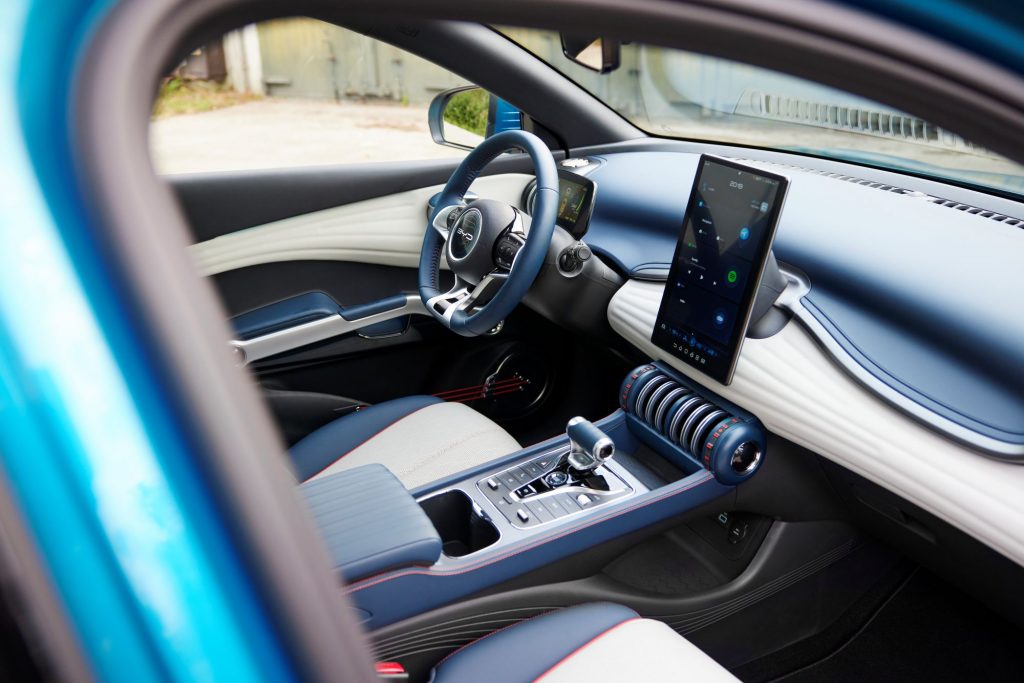
From inside, Atto 3 is not just another grey-on-grey crossover. The cabin design is unique, playful, and frankly speaking a bit strange.
According to BYD, the theme is inspired by a gym. And it’s obvious once you’re inside. The door handles mimic barbell grips and loop around the speakers. The gear selector resembles a kettlebell handle. Even the centre armrest is shaped like a treadmill rail.
Quality-wise, it’s a mix. Upper surfaces feel soft and well-finished, with buttery-soft vegan leather in all trims. Though, lower plastics are much harsher. Sharp edges around the steering column adjuster are easy to catch your hand on.
Then there are the guitar-string door bins. Yes, really. Four elastic cords stretch across each door panel. They’re styled to look musical and, oddly, they work. You can pluck them. Fun for five minutes. Less fun if your kids discover them mid-journey.
The driving position is nicely elevated, which helps forward visibility, but the thick front pillars block your view at junctions. It’s an issue that’s hard to ignore.
All versions get LED headlights, automatic high beam, front and rear parking sensors, and a 360-degree camera.
Infotainment & Driver Display
The infotainment is one of the highlights. The 15.6-inch rotating touchscreen in the Design trim works well. Portrait mode suits maps. Landscape works better for media. It’s quick to respond and looks sharp. The screen in the Comfort trim is slightly smaller at 12.8 inches, but still rotates and includes Android Auto, Apple CarPlay. But wireless charging is exclusive to the Design trim.
The digital driver’s display is not as convincing. It’s small, just five inches, with limited customisation and average screen quality. Most rivals do better.
We’d say, It’s a memorable cabin, quite unusual, well-specced, but not without flaws. Style and substance meet, though not always equally.
Space, Practicality & Comfort
Adviser Rating: 3.7/5
The Atto 3 gets the fundamentals right on the practicality front. The rear 440-litre boot is a solid size. We managed to fit six carry-on cases under the parcel shelf without any issue. On top of that, It can be expanded to 1,338 litres with the rear seats folded down.
The height-adjustable floor helps too. Set it high and there’s barely any loading lip. The rear seats fold 60/40, however, they don’t recline or slide.
Also, there’s no ski hatch and no neat solution for longer items. You won’t find a front storage space, either. Despite a large empty space above the motor, BYD hasn’t lined or enclosed it for cable storage.
Looking at it from the inside, the front of the cabin is packed with some useful storage.
- You get a cubby under the armrest
- Two large cupholders with adjustable bases
- A wireless charging shelf ahead of the gear selector
There’s also an open space under the floating centre console, with USB ports and a 12V socket. The glove box is a good size. Door pockets use elastic strings instead of nets, styled like bass guitar strings. Yes, they’re strummable. Could be fun in traffic, less so with children in the back.
Rear seat space is mixed. Legroom is good, because of a flat floor and decent knee clearance. Headroom is tight, in particular with the standard panoramic roof. The seats are fixed in place with no sliding base, no recline adjustment. Pockets on the seat backs are well thought out, with spaces for tablets, phones, and sunglasses. ISOFIX is fitted on the outer rear seats and the front passenger seat.
Front seats are electrically adjustable, but there’s no lumbar support available on any trim. Hence, on longer journeys, it’s not suitable, particularly for people who already have back issues. That’s a miss in a car pitched as family-friendly.
We’d say In day-to-day use, it works well. But on longer journey’s it’s not that comfortable.
Running Costs & Tax
Adviser Rating: 4.6/5
Electric cars are cheaper to run than petrol or diesel ones, and the Atto 3 is no exception. It’s not the most efficient EV on sale, but running costs still work in your favour.
We averaged approx 3.3 miles per kWh in mixed conditions. Not the best but quite reasonable. You’ll do better around town and in warm weather. Public charging is not the cheapest way to top up. But if you’re charging at home on a standard rate, energy costs stay low.
Being electric, the Atto 3 qualifies for the lowest road tax bracket. You’ll pay just £0 in the first year, then £195 annually after that. It also slips under the threshold for the luxury car tax. Even in top-spec Design trim. That’s a useful saving over rivals that nudge above the £40,000 mark.
Company car drivers get a good deal too. The Atto 3 sits in the 2% Benefit-in-Kind (BIK) band, so monthly tax bills are minimal compared to combustion models. That makes it an appealing choice for business users.
Insurance groupings haven’t caused any surprises so far. Servicing is likely to be inexpensive as well. However, BYD’s UK dealer network is still limited, so availability of service slots or parts could be worth checking if you live outside major cities.
At the end, Atto 3 is not the cheapest EV on the market, nor does it break the bank to run.
Reliability & Safety
Adviser Rating: 4.6/5
The Atto 3 scored five stars in Euro NCAP’s 2022 crash tests. That puts it alongside the safest cars in its class. It achieved 91% for adult protection and 89% for child safety. That’s the kind of reassurance most families will want. All models come with three ISOFIX points, including one in the front passenger seat.
There’s no missing safety kit, either. Every Atto 3 includes:
- Automatic Emergency Braking
- Lane-Keeping Assist
- Blind-Spot Detection
- Traffic-Sign Recognition
- Rear Cross-Traffic Alert
- Adaptive Cruise Control
It’s all standard. No extra packs. No hidden costs.
Talking of warranty cover, it’s decent but not market-leading. BYD offers a four-year, 70,000-mile vehicle warranty. That beats most European rivals, offering three years.
The electric motor and control unit are covered for eight years or 90,000 miles.
The battery has its own warranty: eight years or 120,000 miles. That’s roughly what we expect in this class.
Electric cars usually prove more reliable than petrol or diesel models. Fewer moving parts, fewer things to go wrong.
Still, the Atto 3 packs in a lot of software and touchscreen features. So far, we’ve seen no serious faults or known issues. Safety equipment is generous, crash protection is strong, and warranty terms are fair.
If BYD can back that up with consistent reliability, it’ll earn long-term trust. But it still has something to prove.
Our Verdict
The BYD Atto 3 is easy to like, but harder to love. It nails the basics: generous equipment, low running costs, and solid safety. For day-to-day driving, it works well, notably in town. But once you push beyond that, the flaws start to show. The handling lacks confidence, the ride feels unsettled at speed, and the range doesn’t live up to the spec sheet.
Nevertheless, it’s good value. The Comfort trim gives you everything you need, without overspending. If you want a well-equipped electric SUV that covers the essentials and doesn’t overcomplicate things, the Atto 3 is worth a look.
Just be realistic about what you’re getting and what you’re not.
If you found this review helpful, you can check out plenty more expert reviews and advice over at Car Adviser.