
Drive a Hyundai Kona, and those Robocop light bars will draw comments at every petrol station. Behind the looks, it is far more sensible than you might expect. There is decent boot space for a weekly shop, generous back seats, and switches that actually click properly.
But how does it perform on the road, and what about the beeping problem? Time to drive right in…
Quick Overview
Adviser Rating: 3.5/5
Most small SUVs are built to offend nobody. The Kona dares to go the other way, and it is better for it. The cabin is roomier than the exterior suggests. Also, the standard equipment is generous for the price and compares well with many rivals.
Where it falls short overall is performance value. No version feels especially quick, and the ride favours comfort over polish. Then there are the safety warnings, which will wear you down long before the styling does.
Pros:
- Standout design in a segment full of lookalikes
- Physical buttons and a separate climate panel (a rarity now)
- Rear-seat space beats most rivals
- Generous kit, even on the entry-level car
- Quiet and settled on long motorway runs
Cons:
- Safety warning chimes that reset every single journey
- Hard, scratchy plastics across the dashboard and doors
- The smaller engines lack outright pace
- The hybrid rides worse than the ordinary petrol
- Residual values are expected to be less competitive than some rivals
Trims & Pricing
Four trims are being offered, and the entry one arguably makes the strongest case.
| Trim | From (approx) | What it adds | Worth the money? |
| Advance | £27,270 | 17-inch alloys, LED headlights, roof rails, dual 12.3-inch screens, dual-zone climate control, keyless entry, front and rear parking sensors, reversing camera, adjustable lumbar support | Yes. Better equipped than the price suggests. |
| N Line | £28,400 | 18-inch alloys, sportier bumpers, body-coloured arch trims, powered boot lid, heated front and rear seats, heated steering wheel, ambient lighting, wireless charging | Arguably. The heated rear seats earn their keep. |
| N Line S | £31,470 | Alcantara and leather trim, three-zone air conditioning, Bose stereo, surround-view cameras, blind-spot monitoring | Only for the safety kit, which cannot be added to cheaper trims. |
| Ultimate | £31,470 | Plainer Advance-style exterior, full-width daytime running lights, black leather seats, opening sunroof | Sensible if the N Line bodykit leaves you cold. |
The jump from Advance to N line gets comfort features most buyers will actually use. The jump beyond that, however, is mostly about materials, and the price climbs precipitously.
Blind-spot monitoring and rear cross-traffic alert are locked behind N Line S. That is a trim upgrade of over £4,000, which is difficult to defend. At the time of writing, these features are only available on higher trims.
Prices by engine
| Engine | Cash price (approx) |
| 1.0-litre petrol | £27,270 |
| 1.6-litre petrol | £27,700 |
| 1.6 hybrid | £31,470 |
These are the approximate figures at the time of writing. For the latest pricing, check the official sources.
Exterior Design & Styling
Adviser rating: 4/5
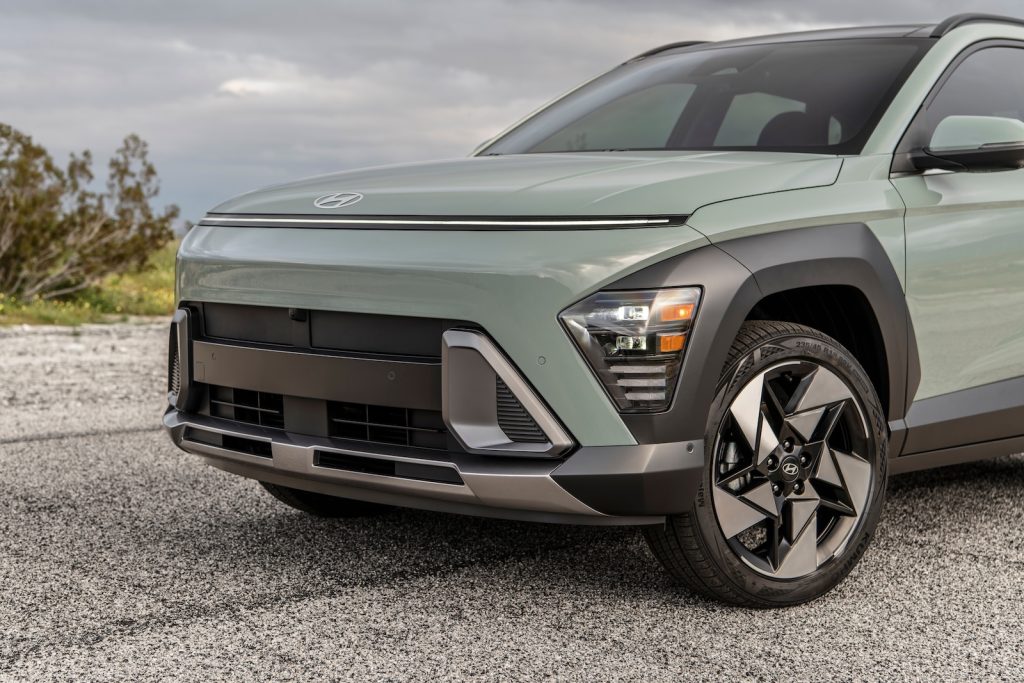
This is where the Kona either wins you over completely or loses you in the first three seconds. There is no middle ground, and Hyundai knew that when signing it off.
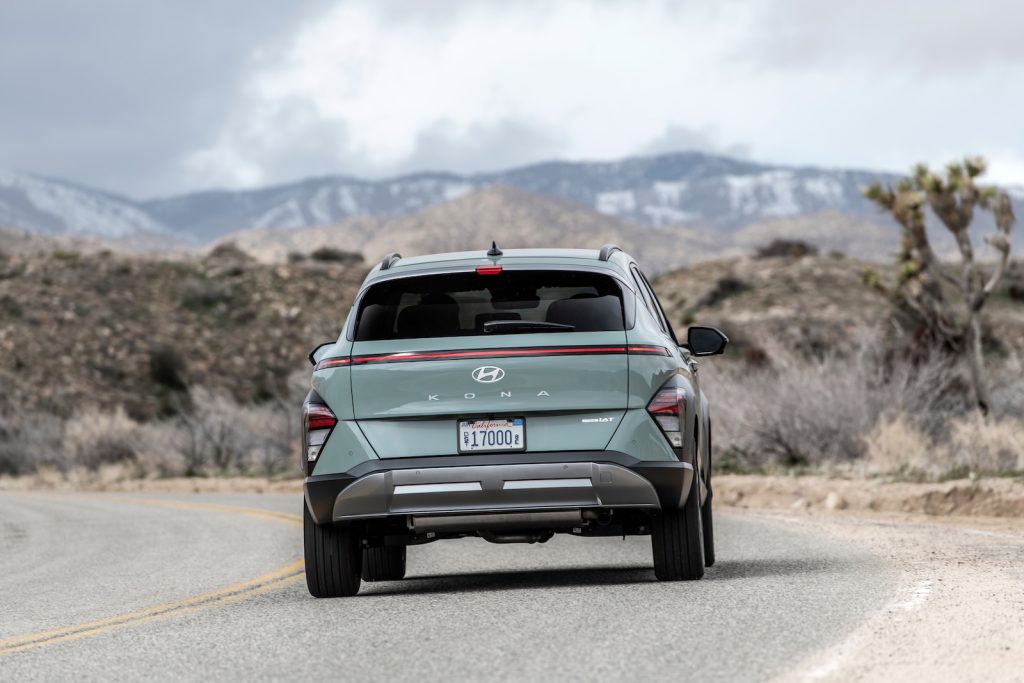
The full-width light bars front and rear are the signature. They stretch the whole width of the car in an unbroken line, and at night the effect stops people mid-conversation. Above them, enormous wheel arch extensions house the actual headlights, which is an inversion of how nearly every other car is arranged.
The front grille is small, and seems like an afterthought. That is because the Kona was developed to accommodate petrol, hybrid and electric powertrains. The result is a front end that looks clean and deliberate, with a smaller grille than most petrol rivals.
The overall design definitely catches attention, but it is not made for everybody. Some may prefer the prettier Renault Captur or the sportier looks of the Ford Puma.
One reservation is that on Advance and Ultimate trims, the wheel arches have black plastic cladding, which cheapens a dramatic shape. The N Line is noticeably cleaner, however.
Performance & Drive
Adviser rating: 3/5
The Engines
You have three choices in petrol, and none of them is brisk.
- 1.0-litre three-cylinder turbo petrol, 120hp (six-speed manual or seven-speed automatic), ~11.8 seconds to 62mph.
- 1.6-litre four-cylinder turbo petrol, 198hp (seven-speed dual-clutch automatic only), ~7.8 seconds.
- 1.6-litre hybrid, 141hp, six-speed dual-clutch automatic only, ~11 seconds.
The 1.6 petrol performs the best. The 1.0 version asks far more of the driver; overtaking needs planning, and long hills want third gear.
The manual gearbox deserves a compliment. Manual shifts have become an afterthought in this class, yet Hyundai has produced one that is light, precise and satisfying to use. Given that most rivals now offer automatics only, this alone might sway a certain kind of buyer.
The Hybrid Question
Skip it if you want to, unless the tax situation makes it unavoidable. That is a firm view, and here is the reasoning. The hybrid barely outruns the 1.0-litre petrol despite costing considerably more, and the engine sounds strained whenever you ask for anything.
The gearbox does not help either. It is a dual-clutch automatic (it changes gear using two clutches rather than the smoother torque converter found in older automatics). It dithers in slow traffic.
The ride is a serious problem in our experience. The hybrid feels firmer over broken surfaces, likely due to differences in suspension tuning and additional weight. That is a rare inversion.
Normally the more expensive version is the more refined one. Here the opposite applies, and the roughly £4,000 premium buys you a worse driving experience alongside better fuel economy.
Ride & Handling
The ordinary petrol Kona rides well and doesn’t feel either floaty or overly firm. Its tall tyre sidewalls and soft suspension absorb potholes and ruts with ease, and there is very little of the head-tossing that afflicts smaller-wheeled crossovers.
It’s not flawless, however. Certain surfaces produce a slight jiggle, and the sharpest ruts still thud through the cabin at speed. A Volkswagen T-Roc glides over speed bumps more gracefully. The gap is narrow, mind, and the Kona comfortably beats the Nissan Juke.
Handling is competent rather than engaging. The steering is light and quick around town (excellent for supermarket car parks), and it firms up sensibly as speed builds. Body lean is well controlled, and the car stays flatter through bends than a Renault Captur.
The Ford Puma, in contrast, is obviously more fun to drive, and very little closes that gap. The Kona is meant to be safe, predictable and reassuring, not thrilling.
The Kona’s refinement is excellent, matching cars from the class above. Wind and road noise are outstandingly low on the motorway.
The Beeping Problem
Now for the section that will decide whether you buy this car.
The driver assistance systems are, frankly speaking, exhausting. The driver monitoring system can be sensitive and may issue alerts even during perfectly normal driving.
Three systems cause most of the trouble:
- Driver monitoring. A long glance in the mirrors counts as inattention.
- Speed limit warning. Exceed the limit by even one mile, and the car will let you know.
- Lane-keeping assistance. Steers you back into the lane if you get too close to the white lines.
Then here is the part that turns irritation into genuine frustration. Most of these systems reactivate every time the engine starts. Turning them off becomes a daily ritual before you can pull away.
You can programme a shortcut button to reach the relevant menu faster, which helps but does not fix the problem. It should not be necessary in a car costing £27,000.
Interior & Tech
Adviser rating: 3/5
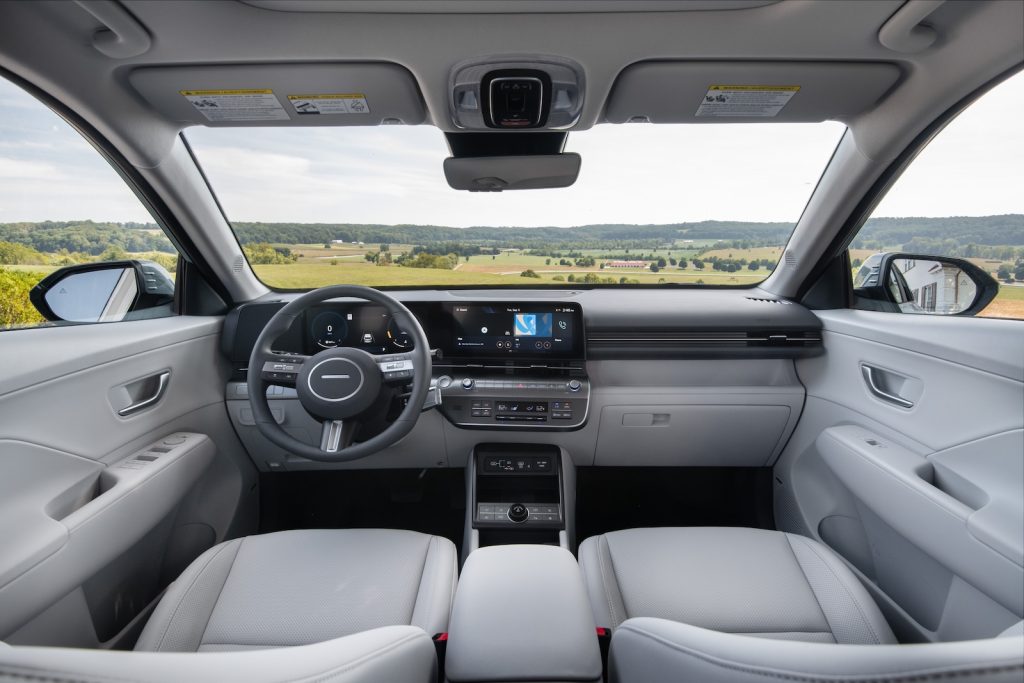
Hyundai has resisted the touchscreen obsession, and the cabin is dramatically better for it.
- There is a separate climate control panel with actual buttons.
- There are physical shortcut keys beneath the infotainment screen.
- The steering wheel carries proper switches and scroll wheels.
- Adjusting the temperature while driving takes half a second, rather than three taps through a menu.
- The twin 12.3-inch displays (one for instruments, one for infotainment) are sharp and quick to respond.
- Apple CarPlay and Android Auto are standard, and the built-in navigation is good enough that you might not bother with your phone.
Now the disappointments…
The materials are ordinary at best. Hard, scratchy plastic dominates the dashboard and door panels, and there is little padding where your elbow naturally falls. A Skoda Kamiq feels appreciably plusher inside for a similar price.
Base Advance trim compounds this with an entirely black cabin. It is functional and slightly grim. N Line adds red stitching and ambient lighting, while Ultimate brings lighter trim and a sunroof that transforms the atmosphere.
Build quality is sound, at least. Everything feels screwed together properly, and the switchgear operates with satisfying weight.
The overall feel of the Kona is not luxurious, but it does feel durable enough.
Space, Practicality & Comfort
Adviser rating: 4.5/5
Front and Rear
In terms of space, this car excels. Anyone over six feet will find ample head and leg room up front. The cabin is wide enough that front passengers are not brushing shoulders. Similarly, the rear legroom is among the best in the class.
Slimmer front seats and a longer wheelbase (the distance between front and rear wheels) have made a measurable difference over the previous Kona.
Three adults across the back is feasible for shorter journeys. The middle passenger straddles a small floor hump, which is standard for the class. Rear air vents and USB-C sockets come as standard, even on the cheapest trim.
Doors open close to ninety degrees, which makes fitting a child seat far less awkward than usual. The ISOFIX anchor points are slightly recessed, so lining things up takes a moment of fiddling. Minor, but worth knowing.
Boot Space
The boot is 466 litres with the rear seats upright, and expandable to 1300 litres when folded. It’s a substantial improvement over the previous generation, which managed a fairly meagre 374 litres.
A split-level floor comes as standard, which is useful for keeping shopping upright or hiding valuables from view. The load lip is low, and the opening is wide, so heavy items slide in without a battle.
One annoyance: folding the rear seats requires reaching in through the back doors. There are no release levers in the boot itself. Most competitors have handled this better.
Storage highlights:
- Large door bins front and rear (unlined, so items rattle)
- Retractable cupholders in the centre console
- Deep cubby beneath the front armrest
- Phone tray below the dashboard
- Underfloor boot storage
Fuel Economy & Running Costs
Adviser rating: 3/5
Official figures suggest up to 47.9mpg for the 1.0-litre petrol and around 44.1mpg for the 1.6-litre. The hybrid claims approximately 60.1mpg.
Real-world results land somewhat lower, as ever. Expect somewhere near 40mpg from the 1.6-litre petrol in mixed driving, and around 50mpg from the hybrid.
For company car drivers, the hybrid’s lower emissions reduce the tax burden meaningfully. Anyone chasing the lowest possible bill should look at the fully electric Kona instead, where the savings are considerably larger.
One caution worth raising. The Kona is expected to lose value more quickly than several rivals. That affects monthly payments on finance deals, because those calculations depend on predicted resale value. A Volkswagen T-Roc may cost more initially and still work out cheaper over three years.
Reliability & Safety
Adviser rating: 3.5/5
The warranty runs five years with no mileage limit, which is unconventional.
Kia, MG and Toyota all offer longer terms, though each comes with conditions Hyundai’s does not.
Anybody covering a serious distance should weigh that carefully.
Euro NCAP tested the Kona in 2023 and awarded 4/5 stars. Adult and child occupant protection scored well, at 80% and 83%. The four-star rating reflects the assessment of both standard safety equipment and assistance system performance.
Standard safety equipment includes:
- Automatic emergency braking (recognises pedestrians and cyclists)
- Lane-keeping assistance
- Driver fatigue monitoring
- Front and rear parking sensors with reversing camera
Blind-spot monitoring and rear cross-traffic alert require N Line S trim or above, and they cannot be added as options to cheaper cars. That is a frustrating restriction, given how useful both features are.
The Verdict
The Hyundai Kona is not the best small SUV, but it does certain things that are hard to beat. The bold styling is one of them, and could be the deciding factor for some. Rear-seat space embarrasses pricier rivals. The physical buttons feel like a quiet act of defiance against the touchscreen obsession. And the five-year unlimited-mileage warranty is worth more than most people realise until they need it.
The beeping could be a problem. It can be, however, managed through a shortcut mentioned earlier in this review, but it is something you have to deal with every journey. Hyundai may fix this with a software update. For now, if you can live with that, the 1.6 petrol in Advance trim makes much sense.