
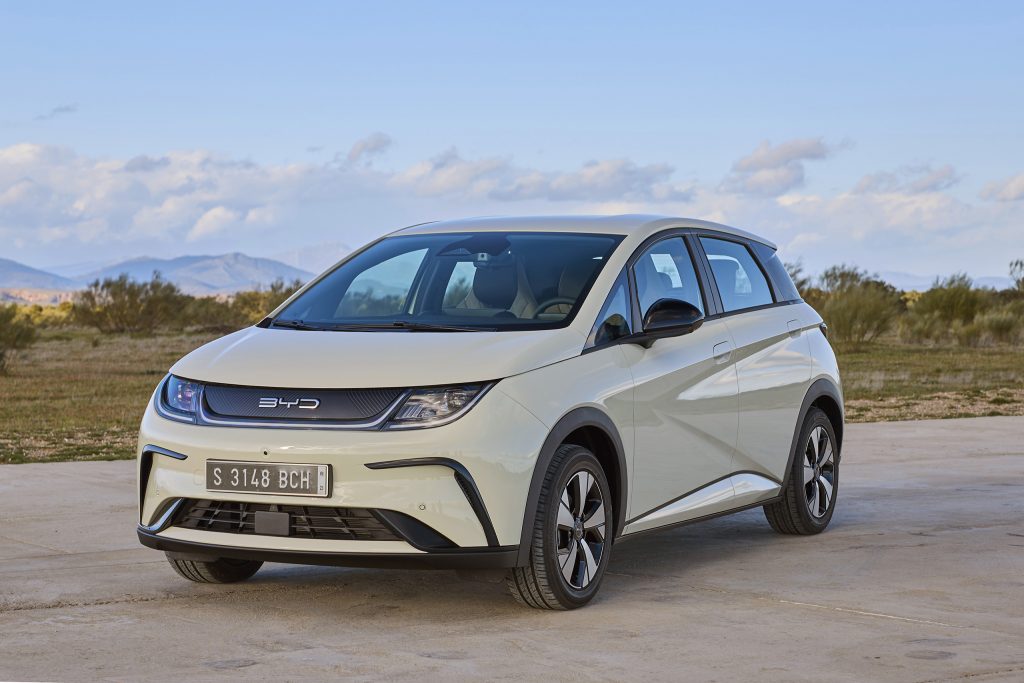
Introduction
With a name like Dolphin, it’s hard not to raise an eyebrow. After all, who would expect to spot one on the M25?
This small electric hatchback sits alongside the Atto 3 and Seal in BYD’s growing UK line-up.
It’s decently equipped, competitively priced, and sounds promising.
But the real question is whether the Dolphin is a serious contender or just a quirky name to chat about on a long motorway drive. Let’s see…
Quick Overview
Adviser Rating: 4.1/5
The BYD Dolphin is a compact electric hatchback focused on everyday usability, strong value, and generous standard equipment. It has two trims – Comfort and Design – now both with a single battery and motor. The range is competitive, and running costs are low.
Interior space is impressive, tech features are plentiful, and safety kit is comprehensive. It’s not built to race or in the premium price bracket, but it does the basics well.
If you want a no-nonsense EV for daily city driving, the Dolphin is worth adding to your shortlist.
Pros:
- Generous standard equipment
- Strong value for money
- Spacious interior
- Low running costs
Cons:
- Only one battery/motor option
- Mild regenerative braking
- Middle rear seat is cramped
Trims & Pricing
Previously, we’ve seen that the BYD Dolphin was available in a wider range of trims, including a cheaper version with a smaller battery. However, that variant is no longer offered. From 2025 onwards, all new Dolphins variants do come with a single setup of 60.4 kWh battery and a 201hp motor.
Although this simplified line-up may suit some buyers, it does remove the lower-cost option that once appealed to more budget-conscious drivers. Plus, this limits flexibility and now if you want a Dolphin under £30,000, you’ll need to look at used stock.
We now have two trims to choose from:
- Comfort – Starts from £30,195
Includes heated front seats, heated steering wheel, adaptive cruise control, lane keep assist, a heat pump, front and rear parking sensors, and a 360-degree camera. - Design – Starts from £31,705
Adds a panoramic glass roof, tinted rear windows, ventilated front seats, a wireless phone charger, and extra interior trim features.
Both variants have an equal official WLTP range of 265 miles. If we compare with competitors like the Peugeot e-208, Renault Megane E-Tech, and Smart #1, the Dolphin gives you more equipment for the money. That being said, it may lack the brand polish of Volkswagen or Cupra, but if value and standard kit matter to you, the Dolphin maintains a strong position.
Performance & Drive
Adviser Rating: 4/5
Let’s talk performance. Dolphin’s both variants come with a single motor of 201hp. In our experience, that’s more than enough for daily use.
City driving is smooth, but on twisty roads, it does feel somewhat less engaging. That’s acceptable since it’s not particularly built for excitement. Rather, it’s built as a daily driving car. But still, we’d argue it’s something to consider.
Dolphin’s compact size and standard 360-degree camera make parking straightforward. However, visibility is limited by thick front and rear pillars. Over-the-shoulder checks and roundabout approaches aren’t as clear as they possibly could be.
On motorways, the Dolphin settles nicely. Wind and road noise are present but not intrusive. The car cruises at speed without any trouble, and the adaptive cruise control works smoothly. It’s comfortable enough for longer journeys.
Acceleration is brisk off the line, and there’s plenty of punch for overtaking or joining motorways.
Now, ride comfort is somewhat mixed. The suspension handles most road imperfections well, including speed bumps. But it can crash through deeper potholes with a noticeable thud. The car feels stiff at times rather than absorbent.
Regenerative braking is mild. Even at its highest setting, it won’t bring the car to a stop without touching the brake pedal. There’s no one-pedal driving mode, which some electric drivers may miss.
It’s not a hot hatch, and it doesn’t try to be one. The Dolphin focuses on usability and low running costs, not thrills, and in the city, that suits it well.
Range, Charging & Tax
Adviser Rating: 4/5
Both Dolphin variants use the same 60.4 kWh battery that has an official WLTP range of 265 miles. That figure is realistic if you drive gently in warmer weather. However, in real-world conditions, we saw around 3.9mi/kWh, which works out to about 263 miles per charge.
Please note that this may vary depending on the weather, road conditions and how you drive.
Dolphin supports 11kW AC charging when charging at home, and it takes roughly 6.5 hours from empty to full. On a DC charger, it supports up to 88kW in the UK. A 10–80% charge takes around 29-36 minutes in ideal conditions.
Several competitors offer slightly faster DC charging. The Peugeot e-208 and Vauxhall Corsa Electric, for instance, both complete a 10–80% charge in around 30 minutes. Still, the Dolphin’s figures remain usable for most drivers and daily needs.
All models include a heat pump as standard. That’s important for winter driving, as it helps preserve range in cold weather.
The charging port is positioned on the right front wing, which may take some adjustment depending on your home charging setup.
From a tax point of view, the Dolphin is about as affordable as it gets. As a fully electric vehicle, it sits in the lowest band of Vehicle Excise Duty. It also avoids the luxury car tax supplement, since both models fall under the £40,000 threshold.
For company car drivers, the Dolphin is highly appealing. It qualifies for the lowest Benefit-in-Kind rate, which makes it an economical option if you’re choosing a company EV.
All in, we’d say that the Dolphin does have decent range, reasonable charging speed, and low tax. It’s a well-suited car for daily use.
Interior & Tech
Adviser Rating: 3.9/5
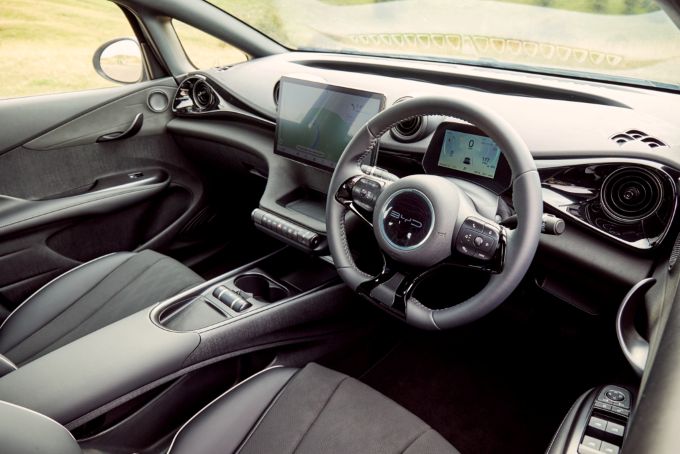
The BYD Dolphin’s cabin looks modern and full of clever touches, though material quality doesn’t quite match the visual impression.
At first glance, it feels like a more expensive car. But some plastics, specifically around the door trims and dashboard, feel hard and scratchy on closer inspection.
Both trims do have heated electric front seats as standard. The driving position is easily adjusted, and the digital display moves with the steering wheel, so visibility is always clear through the spokes.
Storage space is generous. There’s a large open shelf under the centre console, a sizeable glove box, and decent cupholders. Door bins are unlined and noisy, but they’re functional.
The notable feature is the 12.8-inch rotating infotainment screen. It can switch between portrait and landscape views at the touch of a button. Except if you’re using Apple CarPlay or Android Auto, as they stay in landscape mode.
That being said, not everything works perfectly. There are no physical climate controls, and basic tasks like adjusting the temperature take several taps. That’s less convenient than using a simple dial. Shortcut buttons are limited, and the clean dashboard design prioritises looks over usability.
Wireless phone charging is only available on the Design trim. Both versions include USB and USB-C ports and a 12V socket in the front. Rear-seat passengers get two USBs and a pair of cupholders.
Voice control is available, but it won’t replace the ease of traditional buttons. Overall, the Dolphin’s tech feels well-featured for the price, but it could be more user-friendly. The screen impresses, but simpler navigation and physical controls would improve day-to-day use.
Space, Practicality & Comfort
Adviser Rating: 4.1/5
In this size bracket, the BYD Dolphin’s cabin is surprisingly roomy. It’s well-designed for daily use, with thoughtful touches and good space for passengers.
In front, there are plenty of adjustments for the seats and the steering wheel. Electric adjustment is standard. The dashboard is low, and the instrument display moves with the wheel, so visibility remains consistent.
Storage is also on the positive side. You get a deep glove box, a large open space beneath the central armrest, and two useful cupholders. The rotating gear selector is neatly integrated into a short control bar. Door bins are average in size and not lined, so items may rattle about when the car is on the move.
Rear Space
Rear passenger space is impressive. Adults over six feet can sit behind each other with room to spare, and the flat floor makes it easier to get comfortable. Foot space under the front seats is just enough to make long trips bearable. Headroom is fine in both trims, but Comfort models without the panoramic roof can feel a bit more enclosed in the back.
The middle seat is narrow and better suited to short journeys or smaller passengers. Three adults across the back will be a squeeze. There are ISOFIX points on both outer rear seats and on the front passenger seat.
Rear passengers get two USB ports and a shared cupholder. If you fold down the armrest, there are two more cupholders.
Boot Space
Boot space stands at 345 litres with the seats up and 1,310 litres with them folded. That’s ahead of rivals like the MG4, Smart #1, and Peugeot e-208. The boot has a two-level floor, with enough room underneath to store charging cables. You’ll need the upper position if you want a flat floor when folding the rear seats.
There’s no front storage space under the bonnet, but the boot does include underfloor space to stash the charging cables.
We reckon for daily family use, the Dolphin’s space and layout are more than up to the task.
Reliability & Safety
Adviser Rating: 4.5/5
BYD is still a fairly new contender in the UK’s car market and has not featured in any major reliability surveys yet. However, BYD is not new to car manufacturing. Globally, it’s a brand that’s been selling more EVs than any other company, outperforming even Tesla.
Given that, we expect a lot from it. As far as our testing goes, we’ve tested several BYD cars and haven’t seen any widespread reports of faults or recurring issues. Electric cars generally have fewer moving parts to go wrong than petrol or diesel models.
In case you run into any problems, BYD offers a solid warranty package. The Dolphin comes with a six-year or 93,750-mile standard warranty. The battery and electric motor are covered for eight years or 125,000 miles. The battery is also guaranteed to retain at least 70% of its original capacity during that period, or it will be replaced.
Safety is a strong point too. The Dolphin was awarded five stars by Euro NCAP in 2023when tested in 2023. It scored well across all categories, including adult and child occupant protection, vulnerable road users, and safety assistance systems.
All models come well-equipped as standard. Safety kit includes:
- Seven airbags
- Blind spot monitoring
- Lane keep assist
- Driver fatigue detection
- High-beam assist
- Adaptive cruise control
- Door opening warning for passing traffic
These systems work together to reduce fatigue and improve awareness, particularly on longer commutes or urban routes.
While it’s too early to draw firm conclusions about long-term reliability, BYD’s warranty support and strong safety credentials make the Dolphin a reassuring choice. It may be from a newer brand in the UK, but the fundamentals are definitely solid.
Our Verdict
The Dolphin possibly will not excite car enthusiasts, and it doesn’t pretend to. But that’s exactly what makes it appealing!
It’s focused, honest, and sensible. It’s an EV built around real-world priorities like comfort, cost, and practicality.
That said, you might find a few compromises, but the overall package works.
It’s the sort of car that you likely never regret buying.
If the Dolphin sounds like your kind of sensible, you’ll find plenty more like it here. Stay with Car Adviser for more no-nonsense reviews.